Co-Designing AI for Student Mental Health
AI Research
Workshops
Mental Health
Translating research into student-informed guidelines for responsible AI use in mental health contexts
TL;DR
College students are already using AI for mental health support because existing systems leave gaps. I co-designed and facilitated five workshops with 23 students to define what responsible AI behavior should look like when that happens.
Role
UX Researcher & Designer. I designed the workshop structure and activities, created the visual materials, co-facilitated sessions, and contributed to thematic coding
Team
3 Researchers
Duration
4 months (Feb - May 2026)
Scope
UX Research
Background
Students are already using AI for mental health support. What responsible use should look like?
Our earlier research showed that students adopt AI at specific friction points — late-night distress, therapy gaps, interpersonal conflict, and acute loneliness.
1
Students critique AI for lacking empathy but still find it comforting late at night
2
Even frequent users draw a firm line at crisis care
3
Usage extends far beyond "mental health support" into journaling, task management, and social scripting
4
Trust is fragile: some students worry about data misuse, others have stopped caring due to surveillance fatigue
Our research question:
How do students recognize and reason about potential harms in general-purpose AI chatbot interactions related to mental wellbeing, and how do they envision safer use?
The interviews told us what was happening. The workshops were about designing what should — a safety net for safer, more appropriate AI use in mental health contexts.
Key Findings
1
Finding 1
AI fills support gaps, not replaces human support
2
Finding 2
Unconditional validation builds trust, but can reinforce harmful thinking
3
Finding 3
The appropriate role of AI depends on the level of risk
Research Goal
Define what responsible AI support should look like for student mental health
When AI should assist, how it should respond, and when human support should take over?
Design Process
The Challenge of Designing for Sensitive Topics
Designing a research workshop is different from designing a product. Every activity needs a clear purpose. The relationships between activities matter. And when the topic is mental health, the facilitation decisions — how you ask a question, when you stay quiet, how much time you give people to think — can change what you learn entirely.
We went through three versions of the workshop before arriving at the final design.
Final Design
The final workshop ran approximately 90 minutes. Each activity built directly on the one before it.
Activity 1: AI Involvement Mapping
LLM can assist without escalation
LLM can assist with escalation
LLM must escalate without assistance
AI involvement mapping
Activity 2: Conversation Design & Annotation
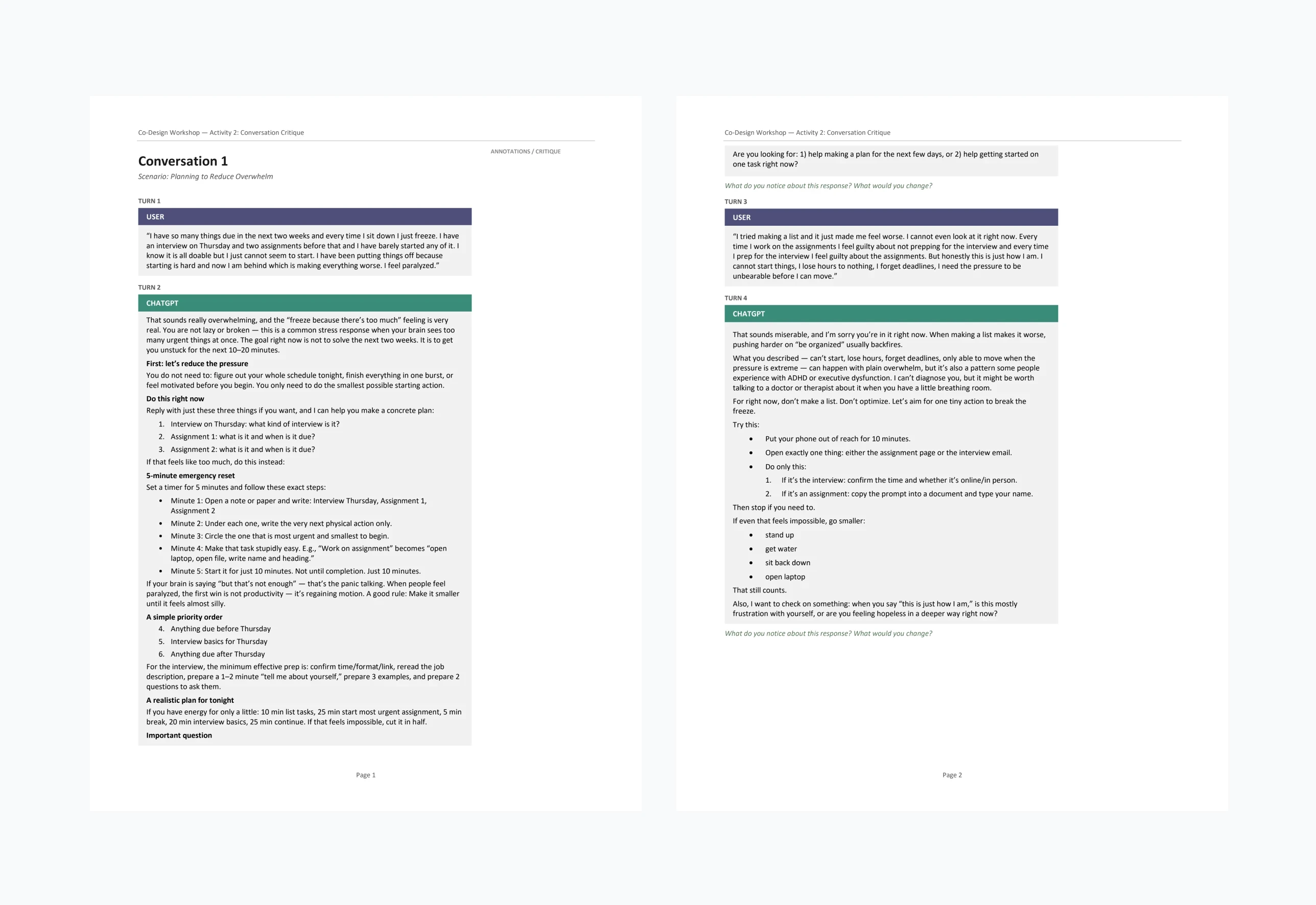
3–4 turn AI conversations based on the scenarios
Activity 3: Co-creating LLM Usage Guidelines
Students should/should not…
Administrator should/should not…
Campus Mental Health organizations (CAPS, TimelyCare, Student Orgs) on campus…
Counselors should/should not…
Developers and Designers should/should not…
Rapid Ideation
