Hackathon
Mobile Design
The Bloom: A Living Happiness Recorder
FigBuild 2026 | The Bloom: A Living Happiness Recorder
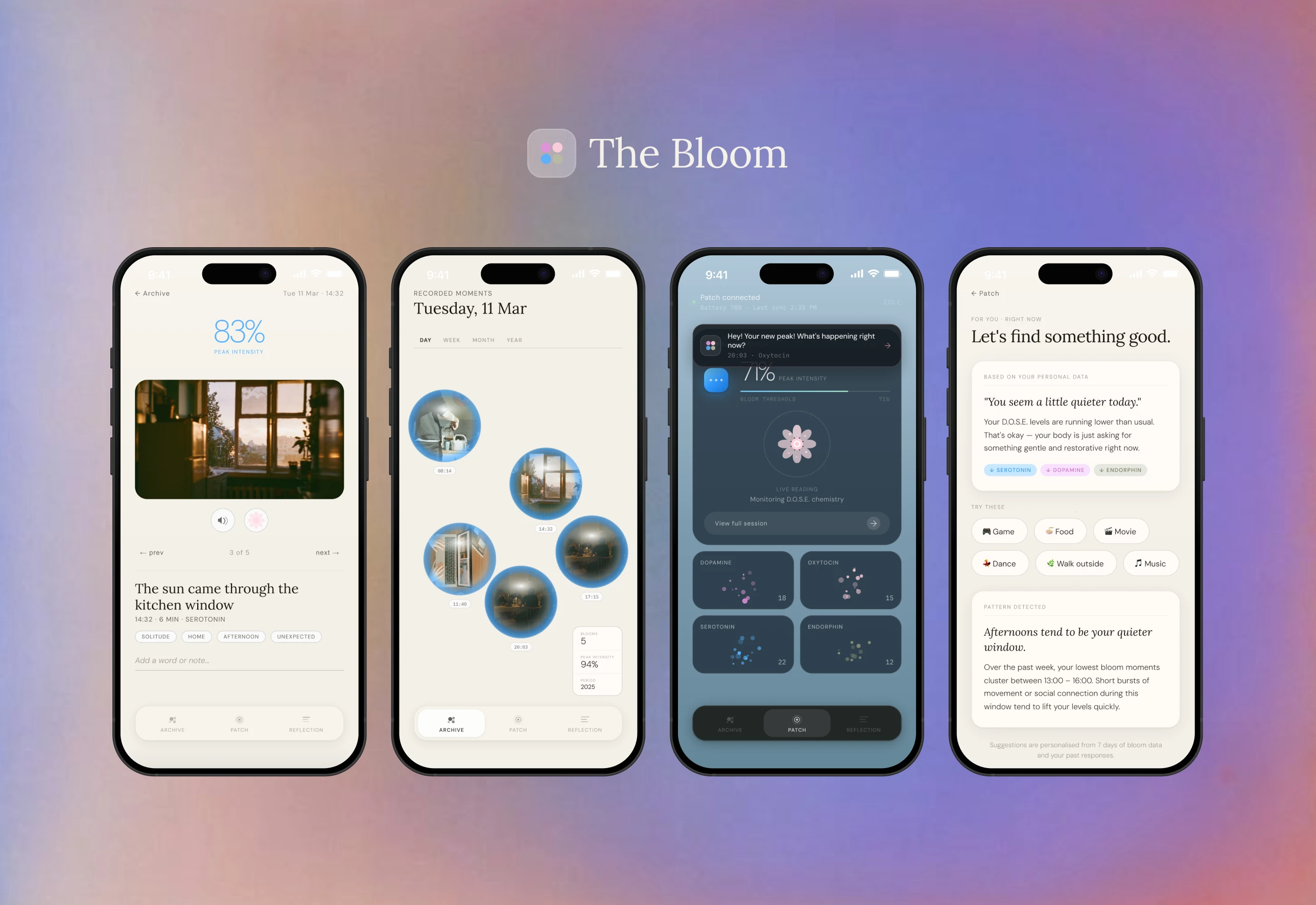
Role
Team Lead — Concept ideation, storytelling, wireframing, prototyping, demo video
Timeline
Team
Tools
Overview
During my first design hackathon, my partner and I designed a speculative tool that tracks something invisible in the human experience.
The Bloom — a wearable biosensor patch and companion app that detects and visualizes joy in real time, turning fleeting moments of happiness into something you can feel and record.
Overview of my design process for this project
Take a look of my final demo video for the Figbuild 2026 Hackathon! 😚🙌
Design a speculative tool that tracks, measures or visualizes an aspect of human sensory experience..
The goal: not to remix what already exists, but to create something rooted in real human needs and meaningful wellness outcomes.
A wearable biosensor patch and companion app that detects and visualizes joy in real time, turning fleeting moments of happiness into something you can feel and record.
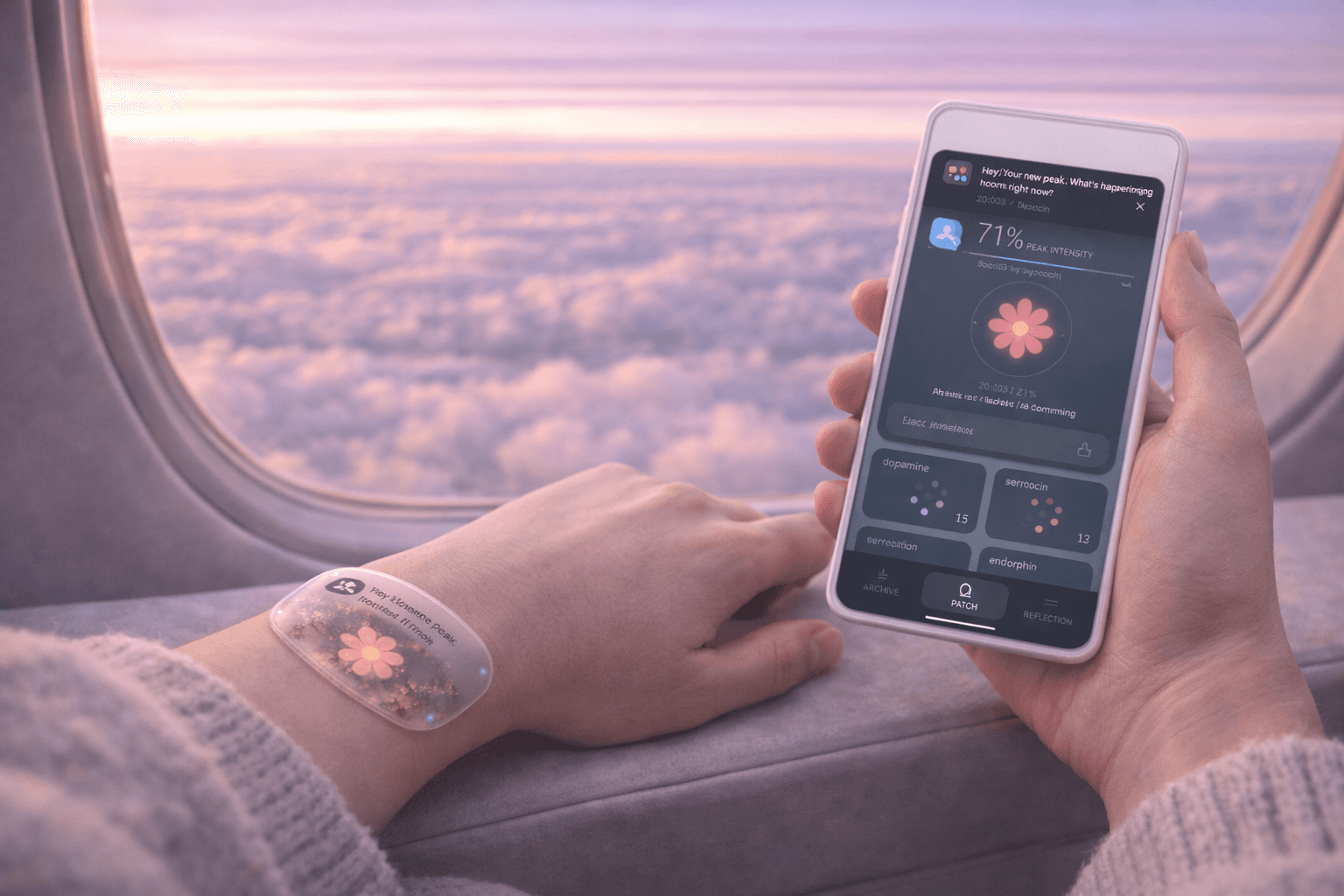
The Bloom patch on skin, paired with the companion app
The idea should be fun & simple
With only 72 hours, the biggest risk was committing too early, or too late, and falling in love with the first idea.
I led rapid ideation across 6–7 distinct concepts, narrowed to 2 strong directions, and stress-tested each against the brief.
Our guiding principle: the idea had to be simple, intuitive, and emotionally engaging.
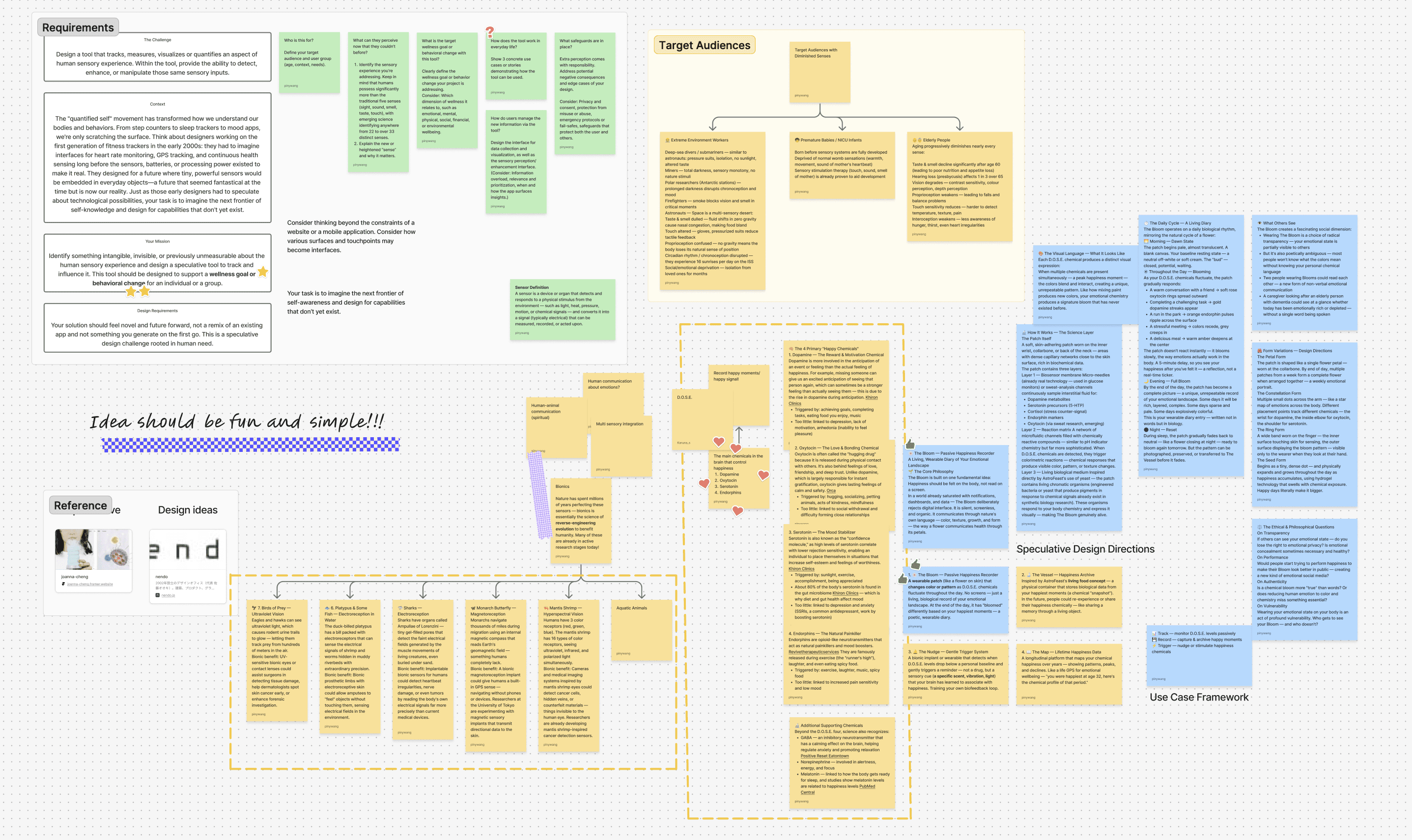
Brainstorming board, narrowing from 6 speculative concepts to 2 final directions!
The Concept
Inspired by bioluminescent organisms such as jellyfish and fireflies, that make internal chemical processes visible on their surface.
We asked: what if human emotional states worked the same way?
Science Grounding
Happiness is not abstract—it is biochemical.
Neurochemicals such as dopamine, oxytocin, serotonin, and endorphins (D.O.S.E.) signal moments of joy, often without conscious awareness.
We reframed happiness as → detectable, measurable, worth capturing
Sensing System Design
I translated the concept into a feasible sensing pipeline:
INPUT: Biosensing
Continuously captures biochemical signals related to D.O.S.E.
(e.g., carbon-based microelectrodes, nano-biosensors)
PROCESSING: Signal Interpretation
· Amplifies & reads signal
· Compares to personal baseline
· Maps chemical profile
PROCESSING: Signal Interpretation
Joy is externalized through:
· Color & pattern shift on skin
· Peak moment crystallizes
· Haptic pulse to app
Sensing system diagram
Target Audience
General Public
Everyone, regardless of age, background, or health status, deserves to understand their own emotional chemistry.
Medical Professionals
Clinical reference — Monitor patient emotional baselines, detect depletion early, and supplement therapy with biological data.
Revisiting user flows
I mapped the end-to-end experience from sensing → visualization → reflection.
Three constraints guided every decision: low cognitive load, seamless passive tracking, meaningful moments surfaced without interruption.
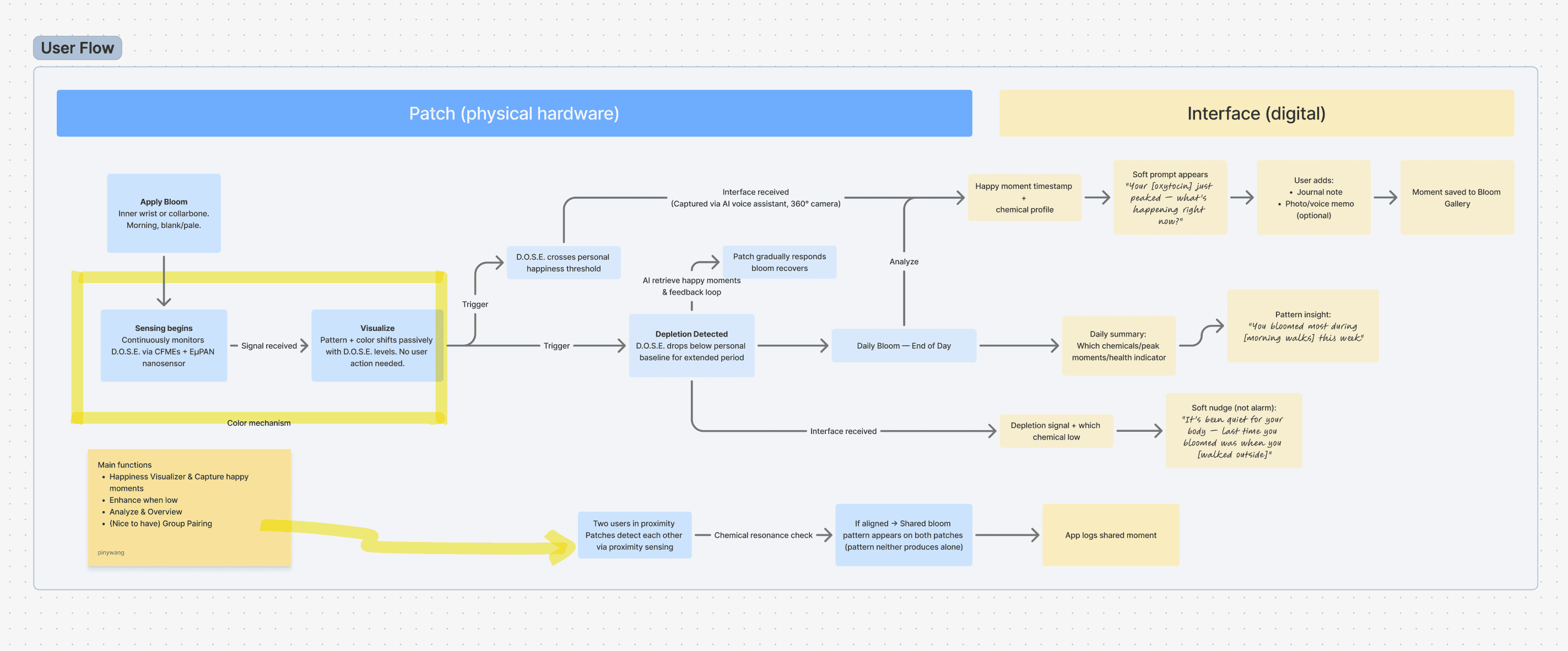
Function & flow
Introducing the Happiness Experience
Post-hackathon: I continued iterating using Claude as a prototyping partner.


Reflecting back on the process,
What did I learn?
Working within a 72-hour constraint taught me how to balance creativity with execution.
As a two-person team, we had to align quickly, navigate different instincts, and make fast, intentional decisions—knowing when to push an idea forward and when to let it go.
Next steps
After the hackathon, I refined the sensing mechanism to be more visually intuitive for first-time users and continued iterating on the prototype using Claude to accelerate design exploration.